


Search for well pump replacement cost and you will find a national average within about four seconds. What is much harder to find is why that average is nearly useless as a prediction of your own bill. Two households with the same failed pump, the same brand and the same age can receive quotes that differ by thousands of dollars, and the reason usually has nothing to do with the pump at all. It has to do with how far down the well it is hanging.
If your well is down right now and you would rather have a real number than a range, call (817) 480-7971 or request an on-site estimate. Every figure below is general market data, and none of it replaces a diagnosis at your wellhead.
What Does Well Pump Replacement Cost in 2026?
Published market data for 2026 puts full well pump replacement at an average of roughly 1,500 to 2,827 dollars. The outer range is far wider, running from a few hundred dollars at the shallow end to well past 5,000 at the deep end.
What the national ranges say by pump type
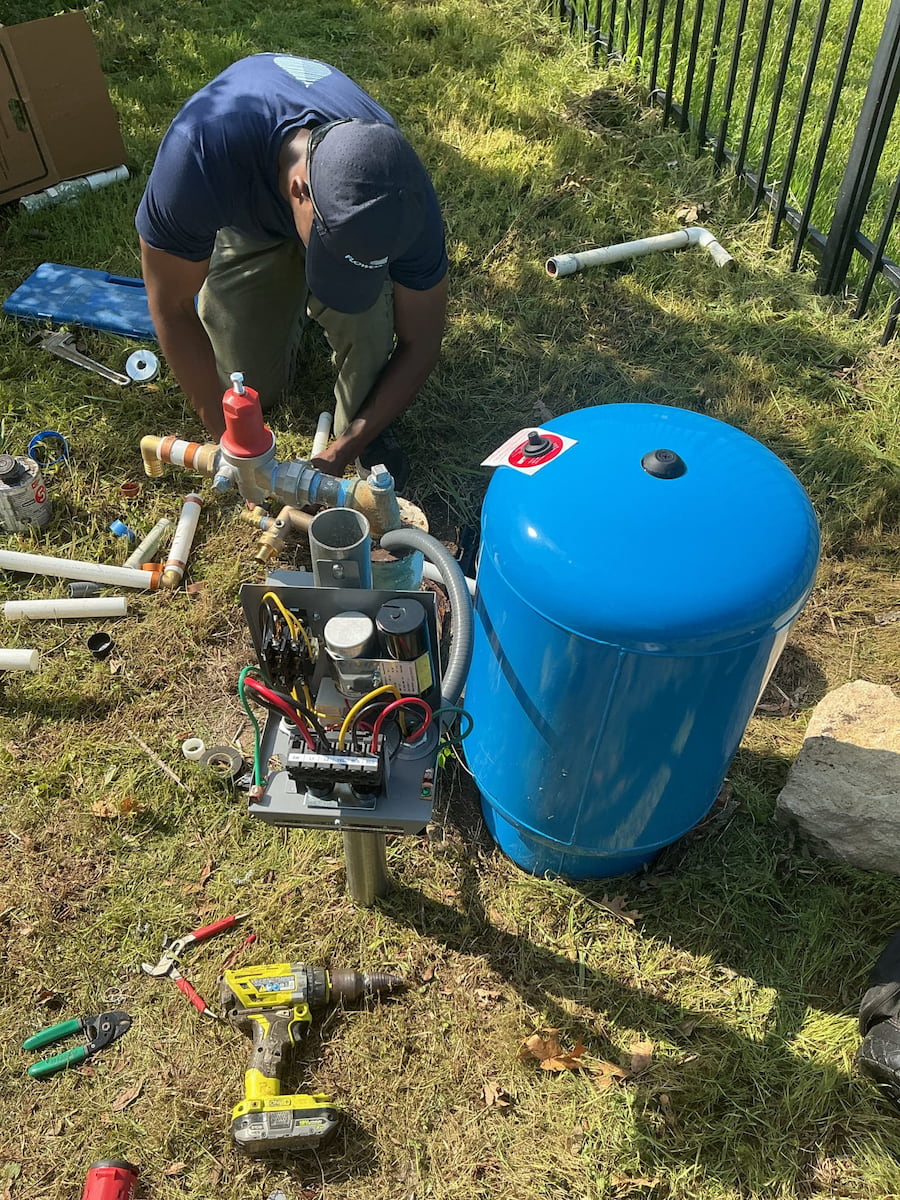
Most of that spread is explained by which kind of pump the well uses, which is itself a function of depth.
A shallow jet pump serving a well under 25 feet is quoted at 300 to 900 dollars.
A deep jet pump on a well between 25 and 100 feet moves up to 500 to 1,500 dollars.
A submersible pump set between 50 and 400 feet or deeper is quoted at 900 to 3,000 dollars or more.
A constant-pressure system, which adds a variable-speed controller to the equation, runs higher still at 2,000 to 5,000 dollars or more.
What is actually on the invoice
The pump itself is one line among several, and homeowners are often surprised by how small a share of the total it represents. Market breakdowns for 2026 put the pump unit at 300 to 1,500 dollars, labor and extraction equipment at 250 to 1,500, drop pipe at 300 to 900, submersible wire at 150 to 750, check valve and torque arrestor at 50 to 200, pitless adapter at 100 to 300, and permits or inspections at 25 to 500.
Read that list again and notice how many entries scale with depth rather than with the pump. Drop pipe, wire and extraction labor are all quantities measured in feet. That is the whole story of why these quotes vary so widely, and it is the part the national averages flatten.
Why Does Depth Move the Number More Than the Pump Does?
Industry figures put the added cost at roughly 500 to 1,000 dollars for every 100 vertical feet of well. That covers the extraction equipment needed to reach the pump and the pipe and wire that come up with it.
The arithmetic of the per-hundred-feet rule
Applied honestly, that rule does something uncomfortable to the national average. A pump at 100 feet and a pump at 500 feet are not modestly different jobs. On the depth factor alone, the deeper well carries somewhere between 2,000 and 4,000 dollars of additional cost before anyone has priced the pump.
This is why a neighbour's bill is a poor predictor of your own even on the same road, and why any quote given over the phone without knowing your well's depth is a guess dressed up as a number.
A worked example from North Texas
North Texas makes the point concretely, because the wells here are well documented and they are deep. Trinity aquifer wells across Denton, Wise, Cooke and Montague counties generally fall between 200 and 800 feet. Drilling records covering 2022 through 2026 put the county averages at roughly 499 feet in Denton County, 514 feet in Cooke County, 420 feet in Collin County, 255 feet in Wise County and 233 feet in Montague County.
Tarrant County sits over a different slice of the same system. The Northern Trinity Groundwater Conservation District, which covers 863.42 square miles above the Trinity and Woodbine aquifers, describes Paluxy sandstones occurring from the surface down to about 1,000 feet and Twin Mountains sandstones at depths between 500 and 2,000 feet.
A submersible pump hanging at 499 feet in Denton County therefore starts near the top of the national submersible range before a wrench is lifted. The national average was never wrong. It was simply calculated across a mix that includes a great many wells nothing like this one.
When Is It a Repair Instead of a Replacement?
Not every well failure is a pump failure, and the difference between the two is the difference between a few hundred dollars and a few thousand. When the fault is above ground, the work stays comparatively contained.
Published 2026 figures put a pressure switch at roughly 120 to 175 dollars, a pressure gauge at 100 to 175, a control box at 200 to 500, a motor start capacitor at 100 to 150, and a foot valve or pitless adapter somewhere in the 150 to 450 range. Labor is generally quoted separately, commonly around 50 dollars per hour plus a flat call fee of 100 to 150.
All of those sit at or near the wellhead and can be diagnosed and replaced without pulling anything out of the ground. Which is precisely why diagnosis before quotation matters so much on a well: the same symptom, no water at the tap, can point at a 150-dollar part or a 3,000-dollar job.
What Else Changes the Final Figure?
Depth sets the baseline. A handful of other factors move the number from there, and most of them are visible before work begins.
Timing matters more than homeowners expect. Emergency and weekend calls carry a labor markup of roughly 25 to 50 percent in published market data, and some after-hours rates run to double the standard figure. That premium applies to labor, not to parts.
The condition of what comes up with the pump matters. Drop pipe and submersible wire as old as the pump are frequently replaced at the same time, because the labor to reach them has already been spent.
Access to the wellhead matters. A wellhead a service truck can pull alongside is a different job from one behind a fence line, under a structure, or at the far end of soft ground.
Permitting can apply depending on the governing groundwater district. Domestic household wells are commonly exempt, but a substantial alteration that causes an exempt well to lose that status can trigger an operating permit requirement.
How Do You Turn a Range Into a Real Number?
Every figure on this page is a market range. The only way to convert one into an actual cost is to find out what has failed and how deep it sits, which means diagnosis before quotation rather than the other way around.
A proper well inspection establishes what the system is doing before anyone commits to a course of action. If the pump does have to come out, pump puller services are what makes that possible on a deep well. Where the diagnosis points toward a failing pump rather than a failed component, our guide to well pump repair versus replacement walks through how that decision gets made.
Once you have a figure in hand, the next question is whether it holds up. A number without an itemized breakdown behind it is not really a quote, and what a written well repair quote should include covers what to look for before you agree to anything.
Flowcore Water handles well repair and pump replacement across North Texas and the DFW Metroplex, including the deeper Trinity wells common through Denton and The Colony and the Tarrant County systems around Kennedale.
Frequently Asked Questions About Well Pump Replacement Cost
How much does it cost to replace a well pump?
General market data for 2026 puts full well pump replacement at an average of roughly 1,500 to 2,827 dollars, with the outer range running from a few hundred dollars to well past 5,000. A shallow jet pump serving a well under 25 feet is quoted at 300 to 900 dollars, while a submersible pump set between 50 and 400 feet or deeper is quoted at 900 to 3,000 dollars or more. These are third-party market ranges, not a quote from any single company.
Why does well depth affect pump replacement cost so much?
Because almost every line on the invoice scales with it. Industry figures put the added cost at roughly 500 to 1,000 dollars for every 100 vertical feet of well, covering the extraction equipment needed to pull the pump plus the drop pipe and submersible wire that come up with it. A pump at 500 feet is not modestly more expensive than one at 100 feet. It is a materially different job.
Can a well pump be repaired instead of replaced?
Often, yes, particularly when the failure is above ground. Pressure switches, pressure gauges, control boxes and capacitors all sit at or near the wellhead and can be replaced without pulling anything. Published 2026 figures put a pressure switch at roughly 120 to 175 dollars and a control box at 200 to 500 dollars. The cost picture changes substantially once the failure is below the wellhead.
What is actually included in a well pump replacement quote?
The pump is one line among several. Market breakdowns for 2026 show the pump unit at 300 to 1,500 dollars, labor and extraction equipment at 250 to 1,500, drop pipe at 300 to 900, submersible wire at 150 to 750, check valve and torque arrestor at 50 to 200, pitless adapter at 100 to 300, and permits or inspections at 25 to 500. A quote that shows only a single total is hiding which of these apply to your well.
Does emergency or weekend service increase the cost?
It typically does. General market data for 2026 shows emergency and weekend work carrying a labor markup of roughly 25 to 50 percent, and some sources report after-hours rates at double the standard hourly figure. That premium applies to labor rather than to parts. If the household still has usable water pressure and the failure is not causing damage, scheduling during normal hours is usually the less expensive path.
Do I need a permit to replace a well pump?
It depends on the governing groundwater district. In Tarrant County, Texas, household wells used solely for domestic purposes are exempt from permitting under the Northern Trinity Groundwater Conservation District, and registering an existing well is free. Wells capable of producing more than 17.36 gallons per minute require permits and reporting, and a substantial alteration that causes an exempt well to lose its exempt status does require an operating permit. Confirm current requirements with your local district before any major work.
No range on this page is a quote, and no honest one could be. If you want to know what your well needs and what it will take to put it right, call (817) 480-7971 and we will come out and look at it.
By Flowcore Water
Licensed TDLR Water Well Driller and Pump Installer. Member of the National Ground Water Association and the Texas Ground Water Association.
Get Pre-Approved Financing
Flowcore Water partners with Greensky to offer convenient financing options for water well services
Flowcore Water Preferred Customer Membership
Enroll today and enjoy the year-long benefits!

