


By Robert Reagan, Flowcore Water · Published September 2026
If you're searching for this at 9 p.m. with no water running in the house, here's the short version: emergency well repair in North Texas typically runs somewhere between $250 and $1,200 for a straightforward pump or component repair, though the number can climb well past that if a full pressure tank or pump replacement turns out to be the actual fix.
The honest answer is that nobody can price a well repair over the phone, and any company that tries to is guessing. This guide walks through what actually drives that price, whether calling after hours costs you more, and when it genuinely makes sense to wait until morning instead of paying an emergency rate.
If your well has stopped producing water right now, you don't need to read the rest of this to know something is wrong. Request an emergency well repair visit from Flowcore Water and a technician can be dispatched the same day across Fort Worth, Dallas, Denton, Mansfield, Carrollton, Saginaw, and Decatur. Call (817) 480-7971 if it's easier to talk it through first.
How Much Does Emergency Well Repair Cost in North Texas?
Emergency well repair in North Texas most often falls between $250 and $1,200, with a repair-only average close to $733 in the Dallas market, according to Angi's local cost data. That figure covers labor and a single failed component, such as a pressure switch or control box. A full pressure tank or pump replacement is a separate job, usually starting around $800 and running past $2,500 depending on well depth and pump type.
Two things push a job outside that range: how far down the pump sits, and whether the failure turns out to be electrical (a $105 to $185 part) or mechanical (a pump or ejector that has to be pulled, which is labor-intensive regardless of the part cost).
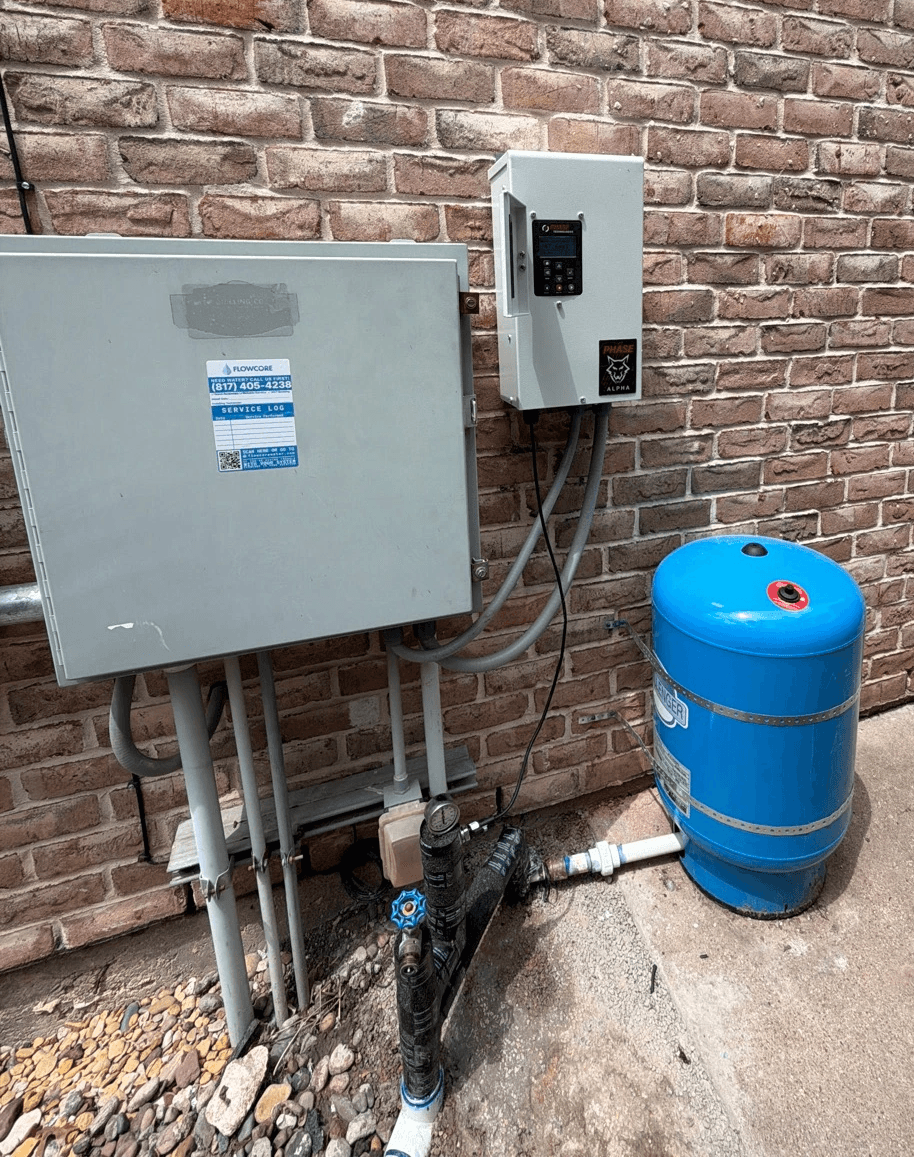
What Drives the Price of an Emergency Well Repair
Three factors decide where a job lands in that range: what's actually broken, how the well is built, and how hard the equipment is to reach.
What Actually Failed
Electrical components are the cheapest fix. A pressure switch runs $125 to $185 installed, a motor start capacitor $105 to $155, and a control box $210 to $520, per Angi's Dallas pricing. Mechanical failures cost more because pulling the pump is most of the labor: a foot valve is $155 to $310, a well ejector $155 to $520, and a pitless adapter $155 to $465. A cracked pressure tank is its own category, typically $800 to $1,500 or more to replace, according to HomeGuide's national cost data.
Well Depth and Wellhead Access
Deep-well jet pumps cost $415 to $825 to repair locally, against $210 to $520 for a shallow-well jet pump, largely because deeper wells take longer to pull equipment from. A wellhead buried under landscaping, boxed in by a deck, or otherwise hard to reach adds time before the actual repair even starts, and that time gets billed the same as diagnostic or repair labor.
Pump Type
Submersible pumps, jet pumps, and shallow-well pumps are priced differently because they fail differently and require different tools to service. A technician needs to know which type is installed before quoting anything, which is one reason phone estimates aren't reliable.
What a Technician Checks Before Quoting a Price
Before any number gets written down, a technician typically checks pressure at the tank, amp draw on the pump motor, the water level inside the casing, and the condition of the wiring running down to the pump. Those four checks narrow the failure down to electrical, mechanical, or a well-yield issue, which is the difference between a $150 part and a job that involves pulling the pump entirely. Skipping this step is how phone quotes end up wrong.
Does After-Hours or Weekend Service Cost More?
Yes. Emergency and weekend well repair labor in the Dallas market runs about $100 an hour, roughly double the standard daytime rate of $50 an hour plus a $100 to $150 trip charge, according to Angi's local labor data. That premium is standard across the well and plumbing trade generally, not specific to any one company.
The premium covers the labor rate, not the parts. A pressure switch costs the same part price at 2 a.m. as it does at 2 p.m. What changes is the hourly labor charge and, in some cases, a dispatch fee for calls outside normal business hours.
Diagnosis First, Then a Written Repair Estimate
A diagnostic visit and a repair are two different costs, and the industry norm is to keep them separate for good reason: an accurate number isn't possible until a technician has actually looked at the equipment. Flowcore Water's own policy, stated on its emergency service page, is to give a written estimate on site before work begins rather than pricing a repair blind over the phone.
That written-estimate step is what protects you from a bad surprise. A phone quote can only ever be a range, because the difference between a $150 pressure switch and an $800 pressure tank isn't visible from the driveway.
A standard daytime service call in the Dallas market runs $100 to $150 as a trip charge before labor is added, according to Angi's local pricing, and it's worth asking upfront whether that fee applies toward the repair if you go ahead with the work. That's a normal industry practice, though it isn't universal, so it's a fair question to ask before a technician arrives rather than after.
Should You Wait Until Morning, or Call Now?
A genuine well emergency means zero water pressure, a pump that won't stop cycling, or any sign of electrical arcing near the pressure tank or control box — those situations get worse by waiting, not better. A well problem that can reasonably wait until morning is one with some pressure still present, an intermittent symptom, or a household that can manage overnight on stored water, since that avoids the after-hours labor premium.
The distinction that matters most is whether the situation is stable or actively deteriorating. No water at all, in a home with no backup source, is not a situation that gets better by morning. A pump that's cycling on and off rapidly is straining a motor that will likely fail completely if left alone overnight. On the other hand, low pressure that's been gradually declining over days or weeks is a sign to schedule a well inspection rather than pay for an emergency dispatch — the problem is real, but it isn't a tonight problem. If you're not sure which category your situation falls into, a quick call to talk through the symptoms costs nothing and can save the after-hours rate.
Whatever the timing, ask what's actually itemized on the estimate before agreeing to the work. Flowcore Water's guide to what a well repair quote should include covers the line items and questions worth asking, separate from the dollar ranges covered here.
If you're dealing with a stubborn pump rather than a failed one, it's also worth checking whether it's simply lost prime before assuming the worst. Flowcore Water's guide to priming a well water pump walks through the check that takes a few minutes and sometimes solves the problem without a service call at all.
Get a Written Estimate Before Any Work Starts
Guessing at a well repair cost from a blog post is a starting point, not a final number — the only way to know what your specific repair costs is to have someone look at the equipment. Flowcore Water covers well pump repair across Fort Worth, Dallas, and the surrounding North Texas counties, with same-day and after-hours dispatch for genuine no-water emergencies. Contact Flowcore Water to schedule a visit, or call (817) 480-7971 if the well has stopped producing water right now.
Get Pre-Approved Financing
Flowcore Water partners with Greensky to offer convenient financing options for water well services
Flowcore Water Preferred Customer Membership
Enroll today and enjoy the year-long benefits!


