


When a water heater starts failing, most homeowners face the same question: fix it, or replace it? The answer isn't always obvious — and it isn't helped by the fact that the company you call has a financial interest in the answer. A plumber who makes more on replacement may steer you toward a new unit when a straightforward repair would have handled the job. One who underprices repairs may skip telling you that the tank is near the end of its useful life.
This guide gives you a framework for making the decision yourself — or at minimum, going into a service call with enough context to know whether the recommendation you're getting makes sense. The short version: age, condition, and the nature of the failure matter far more than any single symptom.
How Old Is Your Water Heater? That's the First Question
Age is the most reliable single input in the repair-or-replace decision. A standard tank water heater has an expected service life of 8 to 12 years when properly maintained — and that range reflects how long the core components typically hold up before wear becomes cumulative rather than isolated.
Before  | After 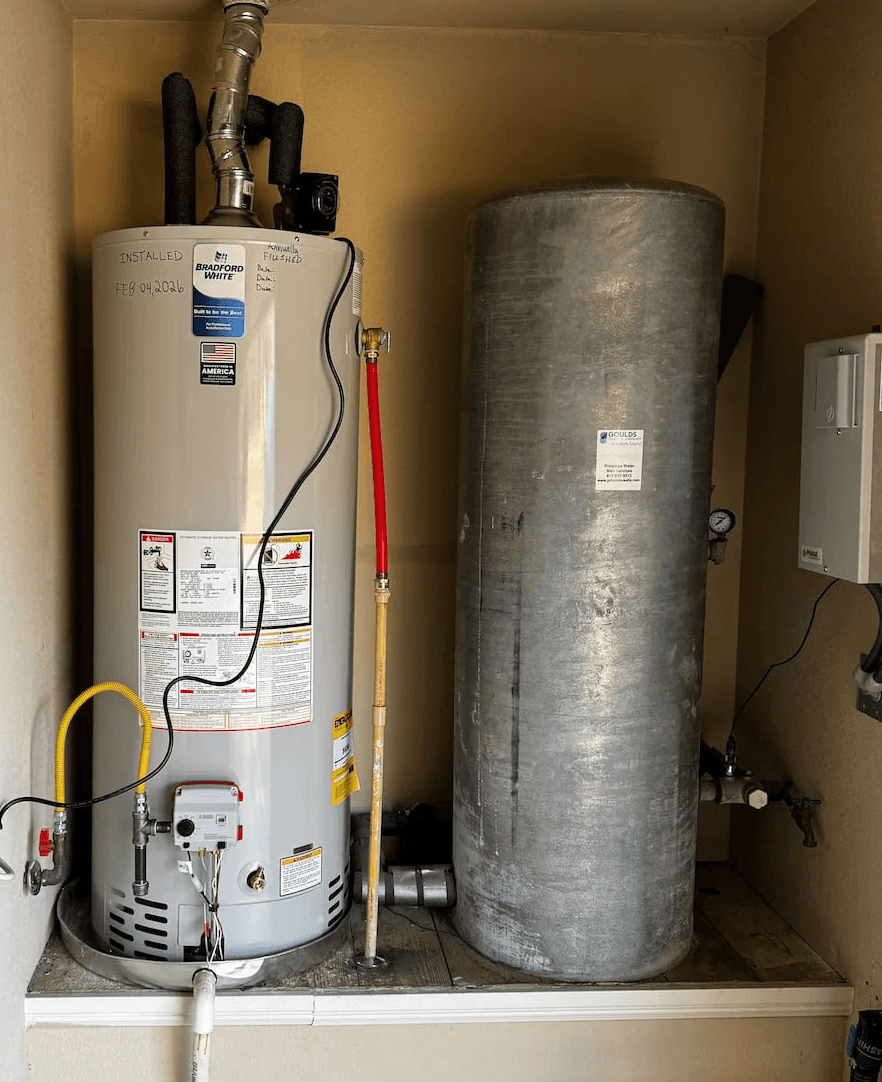 |
Under 8 years: If the unit is under eight years old and has a clearly defined, single-component failure, repair is almost always the right call. The tank has substantial life remaining, the components are serviceable, and there's no structural reason to replace it. Heating element replacement, thermostat service, anode rod replacement — these are all sound repairs on a young unit.
8 to 12 years: This is the evaluation zone. Age alone doesn't determine the answer here, but it changes the calculus. A unit in this range with its first isolated failure may still be worth repairing. One that has already needed multiple repair visits, or that shows signs of tank corrosion, is approaching replacement territory.
Over 12 years: At this point, replacement is usually the more reliable long-term path — even for a problem that looks repairable. What looks like a single failure on an older unit is often the leading edge of multiple failures coming in close succession. Repairing a 13-year-old water heater can feel like winning a battle and losing a war.
In North Texas, where water mineral content runs moderately hard across most of the DFW Metroplex, these thresholds can compress slightly. Hard water accelerates anode rod deterioration and sediment accumulation — both of which shorten effective tank life in the absence of consistent annual maintenance.
What Is the 50% Rule — and Does It Apply Here?
The 50% rule is the standard rule of thumb for major appliance repair decisions, and it applies reasonably well to water heaters. The principle: if the cost of repair exceeds 50% of the cost of a comparable replacement, replacement is generally the smarter financial move.
In practice, the calculation also accounts for remaining lifespan. A $400 repair on a water heater with five or more years of useful life left is a different calculation than a $400 repair on a unit that is already showing multiple signs of end-of-life deterioration. There's a useful extension of this rule: multiply the unit's age by the cost of the repair. If that number exceeds the cost of a new unit, replacement wins. The logic is that an older unit with a costly repair is likely to need another repair soon — and you'll end up paying for both.
Neither formula is absolute. A repair that runs over the 50% threshold on a well-maintained unit in otherwise solid condition can still make sense. These are inputs, not verdicts.
What Warning Signs Point Toward Replacement, Not Repair?
Some symptoms indicate replacement regardless of age or repair cost. These are the ones that carry weight:
Corrosion or rust on the tank exterior, particularly near seams or the bottom panel. External rust frequently reflects internal deterioration — the anode rod has been depleted, the internal lining has been compromised, and the tank is beginning to fail structurally.
Discolored or rusty water from the hot tap that doesn't clear after running the line for several minutes. Once a tank produces consistently discolored water, it has typically reached a state of internal corrosion that no repair addresses.
Water pooling beneath the unit from the tank body itself — not from a fitting or connection. A fitting leak is a repair. A leak originating from the tank body is a structural failure. There's no se
Header 1 | Header 2 | Header 3 |
|---|---|---|
Cell 1-1 | Cell 1-2 | Cell 1-3 |
Cell 2-1 | Cell 2-2 | Cell 2-3 |
rviceable fix for a tank that is corroding through.
Multiple component failures in a short window. One heating element failing is an isolated event. An element failure followed two months later by a thermostat issue, then a pressure relief valve problem — this is a unit showing systemic wear. The next failure is likely already developing.
Severe rumbling or cracking sounds from the tank under load, particularly in an older unit, indicate calcified sediment buildup that has hardened around the heating elements. In advanced cases, this accelerates overheating and structural fatigue.
When Is Repair the Smarter Call?
Repair makes the most sense when the failure is specific, isolated, and occurs in a unit that is otherwise in sound structural condition. A heating element that burns out in a six-year-old electric water heater is the clearest example — the component is serviceable, the tank has useful life remaining, and a straightforward replacement restores full function.
The same applies to thermostat failures, pressure relief valve replacements, and anode rod service in younger units. These are wear components designed to be replaced — their failure doesn't indicate anything broader about the unit's condition. Even in older units, repair can occasionally be the right call when the failure is the first the unit has had, the tank body is clean and intact, and the cost-of-ownership math still favors repair over capital expenditure.
If you want a clear read on where your unit stands, Flowcore's water heater repair service starts with an honest assessment of the unit's actual condition before any work is recommended.
Does It Matter Whether You Have Gas or Electric?
The repair-or-replace framework is the same regardless of fuel type, but there are practical differences worth knowing.
Electric water heaters have two heating elements — upper and lower. Element failure is by far the most common cause of hot water problems in electric units, and element replacement is a low-cost, straightforward repair. Electric units also tend to have slightly longer service lives in equivalent conditions, partly because they have fewer combustion components.
Gas water heaters introduce additional components — the thermocouple, pilot assembly or electronic ignition, and the gas valve — that can fail independently of the tank condition. Many of these present as "no hot water" and are fully repairable without any implication for the tank itself. A failed thermocouple on a five-year-old gas unit is a modest repair, not a replacement conversation.
Where gas and electric converge is at the tank body. Corrosion, structural leaks, and sediment accumulation affect both fuel types equally. Tank condition is the deciding factor in both cases.
What If You're Also Considering a Switch to Tankless?
If you've reached the conclusion that your current unit needs replacement, that decision is the natural point to evaluate whether a tankless system makes sense for your household. The advantages of tankless are real: on-demand heating eliminates standby heat loss, and tankless units typically have a longer service life than tank units — often 15 to 20 years with proper maintenance.
The practical considerations in North Texas are also real. The region's moderately hard water accelerates scale buildup in tankless heat exchangers, which makes annual descaling a maintenance requirement rather than an option. Tankless units also require higher gas line flow rates or electrical capacity than most existing setups were designed for, adding to upfront installation cost.
The honest answer is that sometimes tankless is the right upgrade and sometimes a high-efficiency tank unit makes more sense. The answer depends on household demand, existing infrastructure, and how long you plan to stay in the home. Flowcore's plumbers can walk through both options before any decision is made. For details on what new installation looks like across DFW, see our water heater installation page.
Frequently Asked Questions About Water Heater Repair vs. Replacement
How do you know when a water heater is too old to repair?
The 8-to-12-year range is the general threshold, but age alone isn't the complete picture. A unit in that range with its first isolated failure and no signs of tank corrosion may still be worth repairing. A unit that has already had multiple repair visits, shows external corrosion, or is producing discolored water is past the point where repair makes long-term sense. Over 12 years, replacement is typically the more reliable path regardless of what the specific failure is.
What is the 50% rule for water heaters?
The 50% rule says: if the cost of repair exceeds 50% of the cost of a comparable replacement, replacement is usually the better financial decision. It accounts for the fact that a costly repair on an aging unit may delay the inevitable by only a short window — and you end up paying for both the repair and the replacement within a few years. It's a useful guideline, not an absolute rule. The remaining useful life of the unit matters alongside the repair cost.
My water heater is leaking — does that mean I have to replace it?
It depends on where the leak is coming from. A leak at a fitting, connection, or the pressure relief valve is a repair — those are specific, serviceable issues. A leak from the tank body itself indicates structural failure and typically means replacement is the right outcome. The tank body cannot be reliably repaired once it has begun corroding through.
When is repair the right call even on an older unit?
If the unit is in the 8-to-12-year range, the failure is its first, the tank body is clean and structurally sound, and the cost of repair is well below the 50% threshold, repair can still be the smarter financial decision. The key question is whether the repair cost makes sense given the unit's remaining useful life. A plumber who has actually looked at the unit can answer that in a way a rule of thumb can't.
How does North Texas water hardness affect how long water heaters last?
North Texas water runs moderately hard across most of the DFW Metroplex, which accelerates mineral deposit buildup inside tank water heaters — particularly on heating elements and the tank floor. Hard water shortens the effective service life of a water heater compared to softer-water markets, especially without annual maintenance. Regular sediment flushing and anode rod replacement are the two interventions that most meaningfully offset this effect.
What should I do if I'm not sure whether to repair or replace my water heater?
Call for a service visit and ask the plumber to explain both options — what repair would cost, what it would fix, and what the honest assessment is of the unit's remaining lifespan. A plumber who gives you only a replacement recommendation without addressing the repair option isn't giving you the full picture. Flowcore's plumbers assess the actual condition of the unit and explain what each path involves before any work is recommended.
If your water heater is giving you trouble and you're not sure which direction makes more sense, Flowcore serves homeowners across North Texas and the DFW Metroplex with honest, straight diagnoses — no default push in either direction. Call (817) 480-7971 or schedule a service visit online. For more on what each path looks like, see Flowcore's water heaters page.
Get Pre-Approved Financing
Flowcore Water partners with Greensky to offer convenient financing options for water well services
Flowcore Water Preferred Customer Membership
Enroll today and enjoy the year-long benefits!


